House Prices in the UK and Plymouth
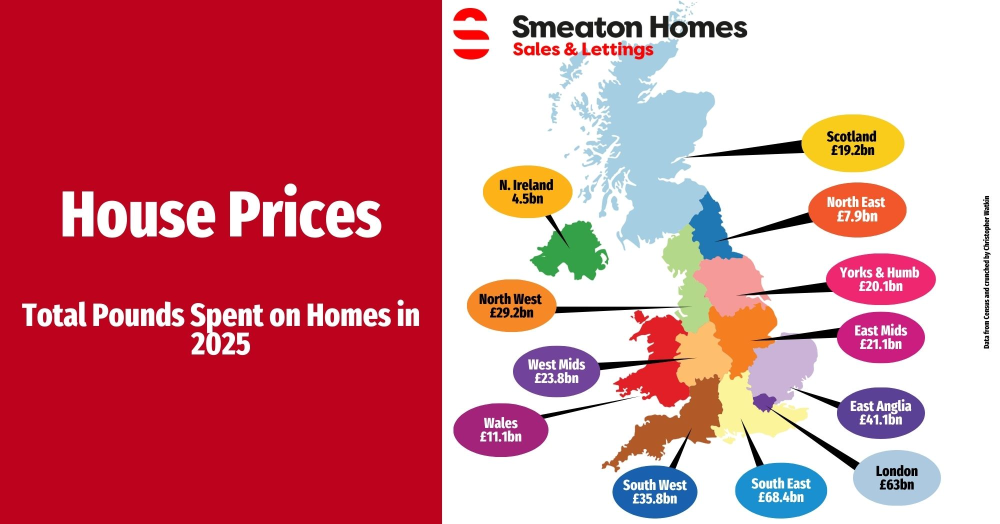
£344 billion.
That is the total amount spent on buying property across Great Britain and Northern Ireland in 2025.
When you strip the noise away and just follow the money, the geography of the property market becomes very clear.
The South East leads the way at £68.4bn, closely followed by London at £63bn. Between them, they account for a huge concentration of housing spend. Not surprising, given population density, price levels and economic gravity.
But look beyond the obvious and the story gets more interesting.
East Anglia quietly clocks in at £41.1bn. The South West reaches £35.8bn. The North West delivers £29.2bn. These are not fringe markets. They are heavyweight contributors.
Even regions often labelled as smaller markets still represent serious economic activity. The Midlands come in with decent levels at £23.8bn in the West and £21.1bn in the East, Yorkshire and Humber at £20.1bn, Scotland records £19.2bn. Wales £11.1bn. The North East £7.9bn. Northern Ireland £4.5bn.
Every one of these figures represents transactions, confidence, lending, equity movement and life decisions being made.
This is not about average prices. It is about scale. It is about where capital is flowing. And when you visualise it this way, the hierarchy becomes obvious.
The property market is not one national story. It is twelve distinct regional engines, each operating at a different intensity.
If you are buying, selling or investing, understanding that regional weight is not optional.
It is essential.
Because in property, geography still determines gravity.
If you are a Plymouth homeowner and would like to discuss where your Plymouth home sits in the market, then we would be more than happy to offer our opinion on a free no obligation valuation by calling us on +44 1752 222060